
Air Flow Made Easy
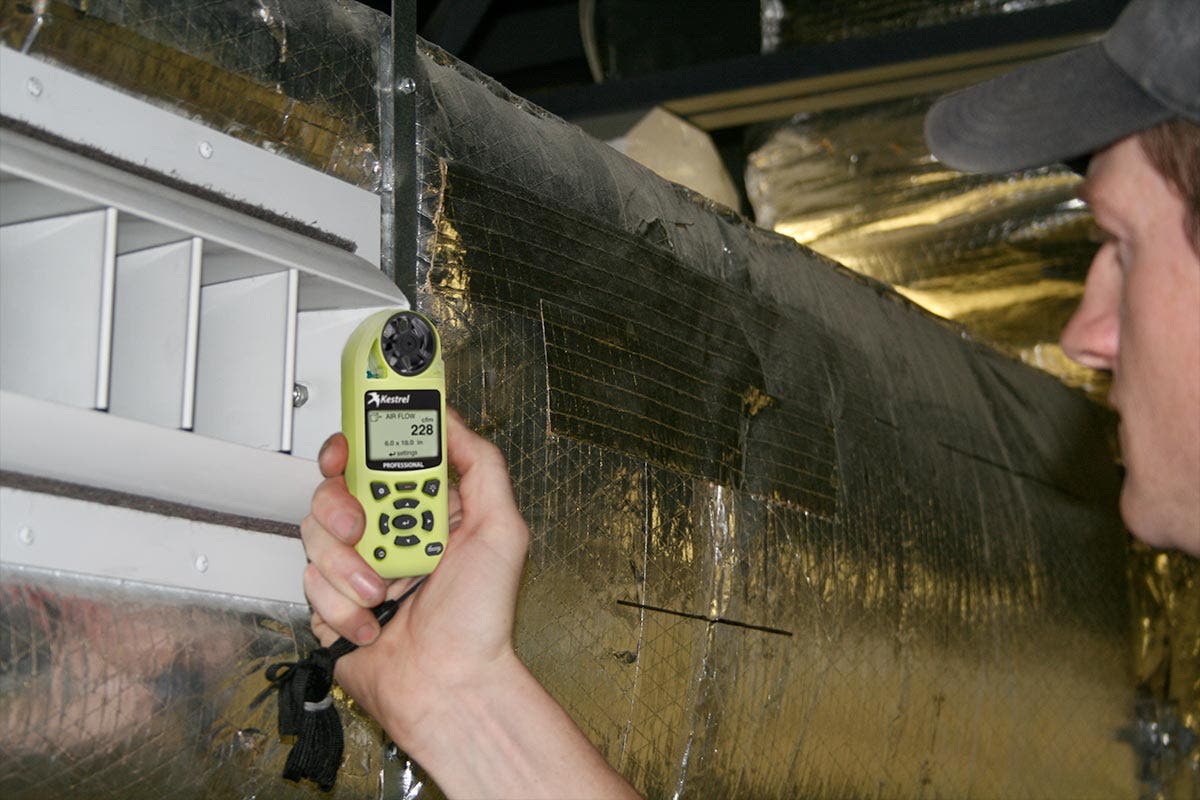
According to Rob Falke, President of the National Comfort Institute, balancing an HVAC system “is the single-most important step that can be taken to assure your systems produce comfort and operate efficiently.” One of the key steps in balancing a system, new or old, is to make sure the airflow coming from each duct is enough to meet demand. ASHRAE Standard 111 covers the procedures to be used when measuring, testing, adjusting, and balancing an HVAC system. While calculations can be made using a few tools and some math, the Kestrel 5200 Professional meter does the work for you. Take a look at the steps involved in determining Volume Air Flow without a Kestrel:
- Measure air velocity and write it down.
- Measure duct dimensions and write them down. (radius, or height and width of opening)
- Calculate cross-sectional area using π(r)2 for circular ducts or x(y) for rectangular ducts.
- Calculate air flow by multiplying area by air velocity
Now compare that to calculating Volume Air Flow using a Kestrel:
- Measure duct duct dimensions and enter them into the Kestrel.
- Hold the Kestrel to the duct opening to directly measure air flow.
The Kestrel 5200 simplifies the process and eliminates the potential for human error when making the various calculations used to determine Volume Air Flow. Not only that, the Kestrel also measures temperature, humidity, and moisture content in air, so you can determine dehumidification needs and the overall comfort level of the home.
Check out the Kestrel 5200 here, and be sure to download our quick and easy log sheet to keep track of measurements throughout the home while doing an HVAC balancing evaluation.

-
 How Does Temperature Monitoring Improve Greenhouse Conditions for Plant Growth?
-
 Announcing the Kestrel® DROP D1 with Probe: The Ultimate Tool for Precision Temperature Monitoring
-
 Understanding Equilibrium Moisture Content and Why It Matters for Construction
-
 Kestrel Adds Vapor Pressure Deficit to the Kestrel 5500FW: Advancing Fire Weather Science
-
 Keeping Canines Cool and Comfortable: How the Pennsylvania Bureau of Dog Law Enforcement Utilizes Kestrel® Meters & DROP Data Loggers